
Biomechanics, the application of physics principles to understand human movement, is one of the research themes of the Sports Engineering Research Group (SERG). It plays an important role in both health care and sports settings, as the learnings from biomechanics can help people move without pain, reduce injury risk, and enhance athletic performance. At SERG we benefit from access to the state-of-the-art biomechanics laboratory at the Advanced Wellbeing Research Centre (AWRC), equipped with a 24-camera motion capture system and 6 force platforms. As well as a portable 8-camera motion capture system that gives us the option to conduct biomechanics measurement outside our laboratory. These devices are the gold-standard of biomechanical assessments. However, their high cost, and complicated and time-consuming operations limit their use to academia and specialist hospitals.
A priority of the SERG biomechanics team is to move biomechanical measurements from laboratory settings to the field, allowing the analysis of movement in representative environments, where subjects can adjust their movements, take decisions in response to external stimuli, and are unrestricted to a limited testing area. The technology to achieve this are inertial measurement units (IMUs), which thanks to their lower costs, small size, ease of use and set-up, represent a valid alternative to lab-based measurement systems. We use the facilities available at the AWRC to compare different measurement systems and help the development of easy-to-use wearable systems that can help the population to independently improve balance and gait, to reduce injury and enhance performance. Within this blog article, we present a recently published example of this work.
Drop foot is a syndrome affecting patients suffering from neurological conditions such as stroke, multiple sclerosis, Parkinson’s disease, and spinal cord trauma. It is characterised by limited foot control that during walking leads to a poor placement of the foot on the ground and the possibility of toe catching during the swing phase, these result in high risk of tripping and falling. Functional electrical stimulation (FES) is used as treatment to improve walking in people with drop foot, it consists of a stimulator with skin surface electrodes attached over the lower leg to induce muscle contractions that correct drop foot.
Etexsense develops textile based wearable medical devices for pain relief and rehabilitation, their products are designed to allow users to manage their conditions at home independently with the intention of improving quality of life and reduced healthcare cost. We worked with Etexsense previously, as part of a AWRC Wellbeing Accelerator project, developing, testing and evaluating their drop foot cuff on users without neurological disease. We demonstrated that the device lifted the foot as well as conventional electrodes, had similar sensation, and was simple to put on and take off, even using only one hand. However, this project did not provide information on the device’s performance and usability in realistic settings.
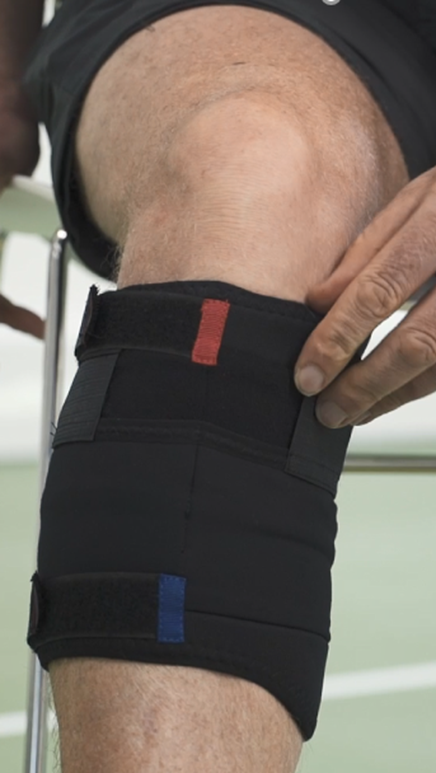
Etexsense cuff
Consequently, we wanted to provide Etexsense with the obvious next step – a tool to allow clinical trials of the cuff to assess gait for drop foot patients and evaluate their device. Due to their suitability for measuring dynamic foot movement and their low participant and researcher burden, two Gait Up IMUs were selected as tool. The accuracy of IMUs has been previously compared against motion capture systems for healthy and impaired participants in the measurements of spatiotemporal parameters (e.g., step/stride length/time), foot clearance (i.e., foot’s height during the swing phase of walking) and foot dorsi-plantar flexion. Whilst studies analysing the accuracy of IMUs in the measurement of foot inversion-eversion are lacking. In addition, IMU’s accuracy in foot kinematics measurement depend on the walking abilities and characteristics of the participants analysed.
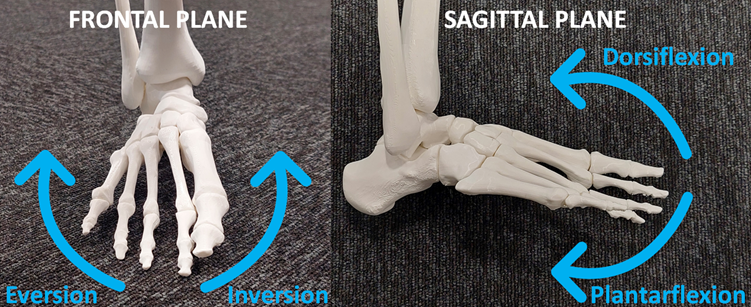
In order to understand drop foot patients’ responses to treatment and rehabilitation with functional electrical stimulation, it is necessary to accurately measure both foot dorsi-plantar flexion and inversion-eversion on these patients. Therefore, we travelled to The National Clinical Functional Electrical Stimulation Centre at Salisbury District Hospital with our 8-camera Qualisys portable system to evaluate the accuracy of the two Gait Up IMUs. We asked thirteen healthy participants and nine affected by drop foot to walk in a straight-line, while we measured the foot motion with motion capture and IMU sensors simultaneously. IMUs were attached on the participants’ shoes, over the laces. Healthy participants were asked to walk at three different speeds and then to simulate drop foot. Drop foot patients were asked to walk with and without FES assistance where possible.
Gait Up IMUs provide only dorsi-plantar flexion angles, therefore, raw data were processed to calculate foot motion in both the sagittal and frontal planes. The angles estimated were compared with the motion capture system to evaluate the agreement between the two measurement systems and answer the following question: can IMUs evaluate foot kinematics in drop foot patients using FES?
Read our lastest paper to find out the answer…
For more information about SERG check out our website, our annual review or our MSc Sports Engineering course.
 Engineering Sport
[…] SERG Biomechanics Group, and our experience of previously providing biomechanics solutions using inertial measurement units (IMUs), gait analysis and motion […]
LikeLike