

Hamstring strains are still one of the most prevalent injuries in sports despite extensive research spanning decades into risk factors, causation, mechanism, and training protocols. The ‘quest’ for injury-free players and optimal performance levels continues to be the holy grail for many researchers. In this article, I invite you on a reflective journey through my PhD from 2017 to the present time. I’ll share some of the high and low points, the progress made, and potential future advancements.
Preventing the Pull
While completing a Masters at the University of Salford, I discovered that the Nordic hamstring exercise (NHE) could serve as an effective indicator of hamstring strength, providing a useful alternative to costly isokinetic equipment (Sconce et al., 2015). By chance, a few years later an opportunity came up to pursue a PhD focused on investigating hamstring injuries through the application of engineering and technology at Sheffield Hallam. Hamstring injuries, the NHE, and testing devices have been widely researched in the literature (look into this at your peril and I suggest a strong coffee when doing so….) which has led to an array of variations in terminology and confusion when trying to compare studies (Sconce et al., 2021a).
From Bench to Field – Ideas, Ideas, Ideas
Many months (turning into years) were spent exploring solutions to address some of the limitations in the existing literature. The bulk of the journey has been spent designing and prototyping devices that can offer useful metrics to support practitioners and athletes in assessing hamstring injury risk. Along the way, I can attest to having my fair share of regrettable ideas and grappled with several failed attempts. Yet, I will say that it is within these failures that the seeds of the most promising ideas have sprouted; coupled with the fact I have got to work with the best Sports Engineering minds in the world! And so it was that the HALHAM° device was born….. (I can confidently take credit for its name).
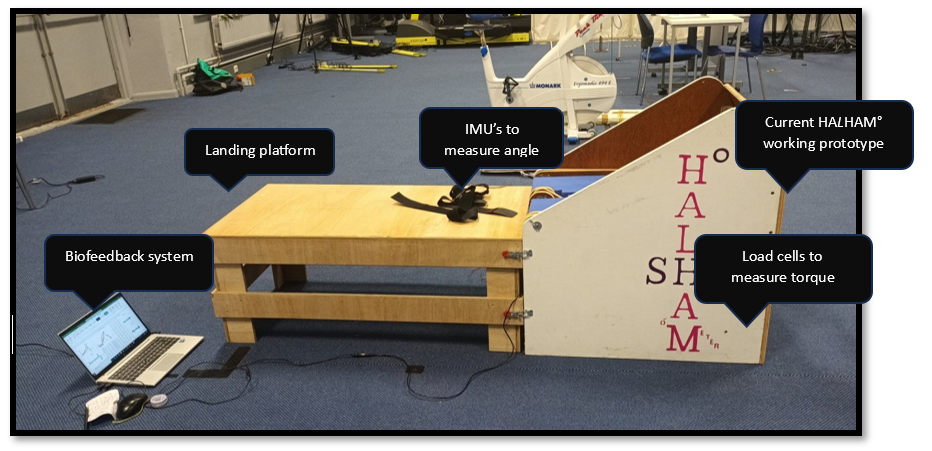
The Incline Hamstring Revolution: Beyond the Flatland – Test the incline: Putting theory into practice, we investigated the use of the device to measure and modify the NHE torque-length relationship of the knee flexors, as targeting the hamstrings at a more extended length may have benefits for injury prevention and rehabilitation (as strains are associated with the hamstrings being subject to high forces during rapid muscle lengthening actions such as in the late swing phase of high-speed running). We found that an inclination mechanism designed as part of the HALHAM° allowed individuals to exercise at a longer muscle length whilst reaching similar torques (Sconce et al., 2021b). A breakthrough……
Hips don’t lie: Biofeedback
Our incline research (Sconce et al., 2021b) revealed that suboptimal NHE technique can be problematic and characterised by excessive hip flexion and speed, resulting in over-estimated torque values and reduced time-under tension. This led us to create a (very cool!) feedback system that allows a participant to observe their hip angle in real-time and follow a mannequin image for a controlled descent.
HALHAM°: Coming to a store near you (maybe..)
Our current device possesses some key design features (feel free to share with friends and family as a handy guide for selecting a great birthday or Christmas gift):
- Measures torque about the knee, making measures more relatable between players.
- Measures torque at the break-point angle of the NHE (termed the break-torque angle) to assess proxy muscle length changes i.e. the angular range over which the torque can be produced.
- The rig uses an angular mechanism that adjusts the inclination to target the knee flexors’ capacity to apply torque over the more greatly extended knee angles, where an injury is most likely to occur.
- Uses a novel, visual integrated feedback system to monitor hip position and knee extension speed.
We are looking to bring this product to market and are actively seeking visionary partners and collaborators who share our passion for innovation. If you’re as excited as us about the HALHAM°, let’s connect and explore opportunities to impact the market, and forge a game-changing deal!
The Haminator: I’ll be back! – Evolving journey
The HALHAM° is constantly evolving but the end of my PhD journey is near and the last project is underway. We will investigate whether incline NHE training can shift the angle of peak torque to a longer muscle length and result in greater fascicle length compared to conventional flat NHE training.
If you would like to know more about the research, my experience of being a PhD student, or be involved in our hamstring intervention study feel free to get in touch either by email, Twitter or LinkedIn. For more information about work we do in SERG check out our website, our annual review or our MSc Sports Engineering course.
‘A picture is worth a thousand words!’ So here is an infographic to provide a visual summary of the article.

References:
Sconce, E. et al. (2015) ‘The validity of the Nordic hamstring lower for a field-based assessment of eccentric hamstring strength’, Journal of Sport Rehabilitation, 24(1), pp. 13–20. doi: 10.1123/jsr.2013-0097.
Sconce, E. et al. (2021a) ‘Agreement between methods and terminology used to assess the kinematics of the Nordic hamstring exercise’, Journal of Sports Sciences, 39(24), pp. 2859–2868. doi: 10.1080/02640414.2021.1968127.
Sconce, E. et al. (2021b) ‘Development of a novel Nordic hamstring exercise device to measure and modify the knee flexors’ torque-length relationship’, Frontiers in Sports and Active Living, 3(629606), pp. 1–9. doi: 10.3389/fspor.2021.629606.
 Engineering Sport