

Image: CC Fernando Frazão (Agência Brasil)
Usain Bolt set world records of 9.58s and 19.19s in the 100m and 200m at the 2009 world championships in Berlin. Those records have stood for well over a decade and don’t look to be imminently under threat. That is despite the innovations in running shoes, originally focussed on long-distance running and breaking the 2-hour barrier for the marathon, achieved by Eliud Kipchoge on 12 October 2019 in the Ineos 1:59 Challenge. This was not an official world record as it was not a race that complied with World Athletics requirements. However, the performance advantage of these “super shoes” was discussed in a previous blog article – Super shoe world records. The performance advantage has extended to the sprint events. Figure 1, taken from the Super shoe world records article, compares the average of the best times from each year from 2021-2023 to the average from 2010-2015 for each event, presenting a ratio of the times.
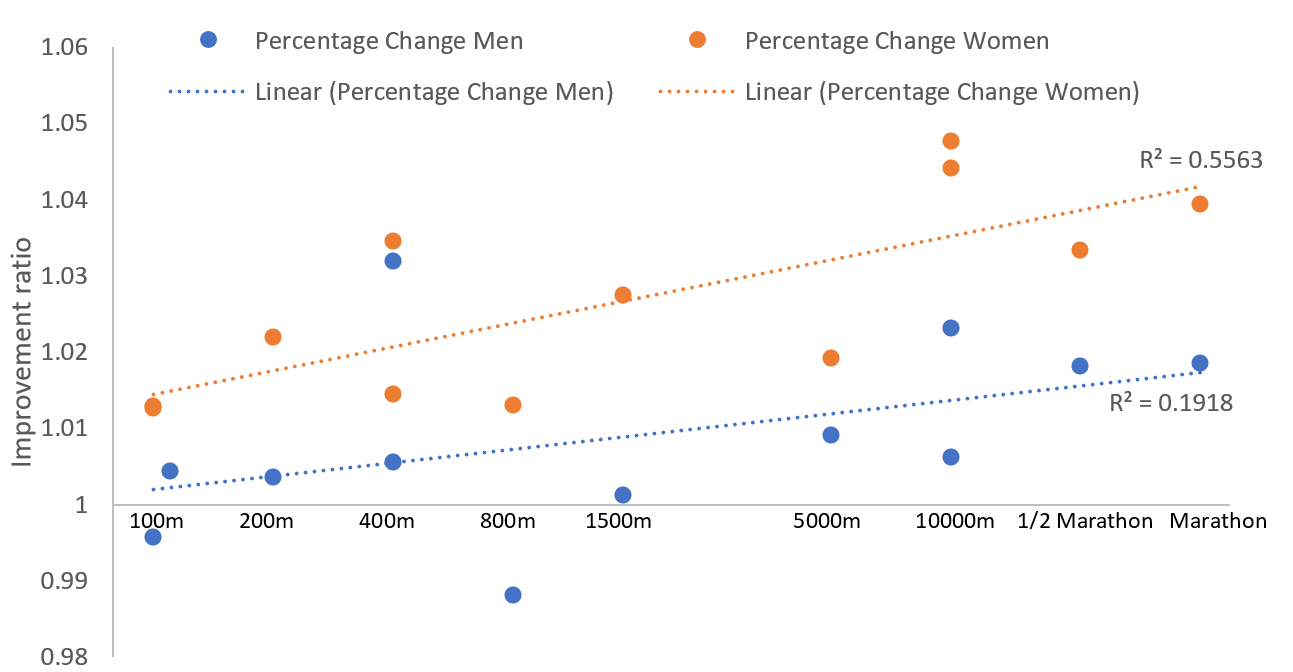
Figure 1. The ratio of the mean yearly best performance from 2021-23 to the mean yearly best performance from 2010-2015. Values greater than 1 show that performances in 2021-2023 were better than in 2010-2015. A logarithmic scale is used on the x-axis.
In Figure 1 we see that the men’s 100m is one of only two events that has not shown an improvement. The pre-super shoe period (2010-2015) was dominated by Usain Bolt but he had stiff competition from Tyson Gay, Yohan Blake, Justin Gatlin and Asafa Powell. It can be argued that all those athletes are better than the current crop of 100m sprinters. Let us assume that Usain Bolt would gain an advantage from these super shoes. We could take the improvement ratio from each of the following:
- The straight line of best fit – an improvement ratio of 1.002. This equates to a time of 9.56s
- The men’s 200m improvement ratio of 1.004. The equates to a time of 9.54s.
- The women’s 100m improvement ratio of 1.019. This equates to a time of 9.40s.
The straight line of best fit is dragged down by the point for the men’s 100m in Figure 1, caused by the lower standard of athletes currently competing in the 100m. So, this provides us with a lower bound of 9.56s for the potential times achieved by Usain Bolt in a super shoe. Women appear to benefit more than men from the super shoe, so the time of 9.40s suggested by using the women’s 100m improvement ratio provides an upper bound. Using the men’s 200m improvement ratio may give a sensible middle ground of 9.54s. More simply for the 200m, we can apply the improvement ratio of the men’s 200m to Usain Bolt’s world record and his time drops to 19.08.
The data suggest that Usain Bolt would run the 100m in about 9.54s and the 200m in 19.08 seconds if he was able to take advantage of the super shoe as the data suggests. This is a significant assumption as different athletes may respond differently to the new shoe technology and gain different levels of performance. Comparing to the best times in 2023 of 9.83 (by Zharnel Hughes, Noah Lyles and Christian Coleman) and 19.47 (by Noah Lyles), we can see that this would put Usain Bolt well clear of the current best in the world. A time of 0.1s is equivalent to roughly 1m, so this puts Usain Bolt 3-4m ahead in events usually won by the smallest margin.
To learn more about our research at the of the Sports Engineering Research Group (SERG) at SHU, please head to either Dr John Kelley SHU website profile or our website. You can also follow us through our social media channels, available at the top right of this page or through our linktr.
 Engineering Sport
