
Our work on the “Design Development of a Repeatable Helmet Test System for Public Order Threat Recreations” has now been published! This paper, presented at the 3rd International Conference on Design Tools and Methods in Industrial Engineering in Florence Italy, explains some of the challenges with laboratory recreations of real-world head impact scenarios, particularly for high threat applications such as Public Order. In this blog we present a brief lay summary of this paper.
Public Order (PO) officers, commonly known as Riot Police, face significant risks of Traumatic Brain Injury (TBI) due to the violent nature of their operations and exposure to blunt weaponry. I, along with supervisory team Dr John Hart, Dr Leon Foster, and Terry Senior, have created a bespoke helmet impact system designed to assess helmet performance under conditions that replicate real-world threats faced by PO officers.
The test system comes as result of challenges with the preliminary laboratory recreations of injurious scenarios. The initial free-fall drop methodology lacked repeatability, particularly when simulating threats such as thrown projectiles. It was also not possible to achieve representative impact velocities without effecting impact accuracy. The newly designed head impact test system addresses this issue using traditional low-friction drop methods, while incorporating biomechanical representation with an anthropometric representative head and neckform. The intention is this system will be used for a broad range of headgear impact testing as it meets the criteria of all non-vehicular vertical drop impact standards.
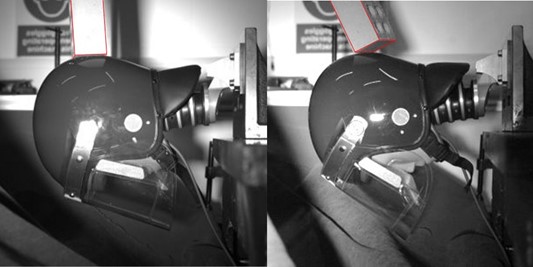
Figure 1, Laboratory recreations of projectile brick impacts that demonstrate poor repeatability with an un-guided drop method.
Guided drop methods were favoured for their flexibility and control over impact energies. The system’s design decisions, such as floor-to-ceiling construction, multi-railed drop guidance, and lightweight drop assembly, were made to ensure versatility and safety. Key components of the impact system, including linear guideway bearings and an aircraft grade aluminium drop plate, were carefully selected to withstand impact loads. These were further optimised using Finite Element Analysis (FEA) to reduce mass and offer more control of the impact energies. The final design incorporates features for improved safety and useability, such as a remote arming mechanism and mechanical release pin.
The significance of the new impact system lies in its ability to recreate PO threat conditions with a high degree of fidelity and repeatability, thus facilitating the development of more effective headgear. By including an Anthropometric Test Device (ATD) headform and neck, the system maintains a degree of biomechanical representativity, crucial for accurately evaluating helmet performance. Certain other impact recreation test systems have facilitated inelastic energy transfer in impacts, which simulate the coupling of the two impacting components after they collide. This can better represent certain in-field conditions and is not yet possible with the drop tower design due to necessary fixed components. Future iterations may explore methods to overcome this limitation while ensuring impact conditions remain repeatable.
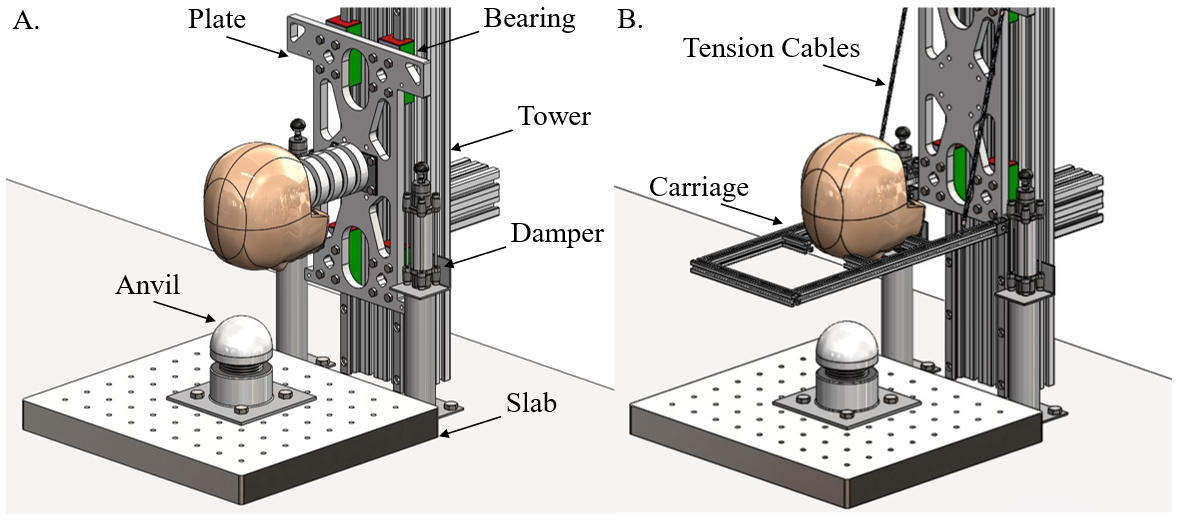
Figure 2, Three-dimensional computer aided design (CAD) model of the helmet impact test system in configurations for affixing anthropometric headforms with (A) and without (B) a representative neck.
In conclusion, the bespoke impact system presents a significant advancement in PO helmet testing. Its versatility, repeatability, and biomechanical representativity make it a valuable tool for understanding in-field loading conditions and guiding the future design of improved protective gear. Validation and research procedures are currently in place to optimise the system’s performance and enhance its applicability in real-world scenario recreations.
You can read the full paper here: DAWBER, W. FOSTER, L. SENIOR, T. and HART, J. (2024). Design development of a repeatable helmet test system for public order threat recreations. In: CARFAGNI, M., FURFERI, R., DI STEFANO, P., GOVERNI, L. and GHERARDINI, F., (eds.) Design Tools and Methods in Industrial Engineering III. International Conference of the Italian Association of Design Methods and Tools for Industrial Engineering, 2 . Springer Nature Switzerland, 169-176.
If you would like to know more about this research follow me (Will Dawber) on Twitter or Linkedin. To learn more about the work we do in SERG check out our website, our annual review or our MSc Sports Engineering course.
 Engineering Sport
Love the site! I blog about the New York Mets, feel free to check out my blog, I’ll follow your blog, can you please follow mine too? Let’s help each other grow! -Mikayla
LikeLike