
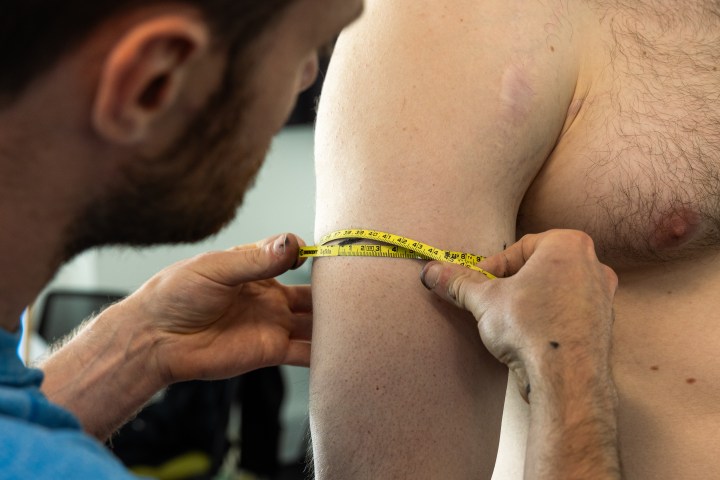
Anthropometry has long provided a way of describing human size, shape, and proportion. Traditionally, its outputs have been datasets, reference values, and population summaries – useful for comparison, surveillance, and classification. Increasingly, however, anthropometric data is no longer an endpoint. It is passed directly into engineering and design processes, shaping physical systems that people must wear, use, or interact with. It is this transition – from measurement to design decision – that sits at the heart of anthropometric engineering.
Berthaume and Kramer have argued that the sustained integration of anthropology and engineering has reached a point where it can no longer be treated as a temporary collaboration or methodological tool. Instead, they propose anthroengineering as an independent interdisciplinary field, focused on translating biological knowledge into engineered solutions. Their argument resonates strongly with current uses of anthropometry, particularly in applied and sports contexts.
Where anthropometric engineering is already at work
In general engineering, anthropometric data informs decisions about fit, clearance, reach, and interface geometry. Examples include seating systems, vehicle interiors, personal protective equipment, and medical devices. In each case, engineers must decide how much body variability to accommodate, which dimensions matter most, and what happens when users fall outside expected ranges. These are not measurement problems alone – they are design and risk decisions built on anthropometric assumptions.
In sports engineering, this translation is even more explicit. Body dimensions influence: equipment sizing and adjustment ranges, load distribution in protective gear, interface pressures at points of contact, and the balance between performance optimisation and injury risk.
Here, anthropometric data is rarely used in isolation. It interacts with biomechanics, materials science, and performance demands. Anthropometric engineering provides a way of framing that interaction, recognising that the same measurement can have very different implications depending on how it is operationalised within a system.
How anthroengineering differs from human factors
Anthropometric engineering is often conflated with human factors or ergonomics, but the distinction is important. Human factors focuses on human–system interaction, prioritising usability, safety, cognition, and behaviour within complex environments. It is typically concerned with how people use systems.
Anthropometric engineering, by contrast, is concerned with how bodies are represented within engineered models. Its emphasis is upstream of interaction: on how measurements, structural variation, and biological constraints are translated into design parameters, tolerances, and constraints.
Both fields overlap and inform one another, but their starting points differ. Anthropometric engineering is less about user experience and more about biological realism in design logic.
Anthropometry as a tool – not the whole process
Critically, this framing reminds us that anthropometry itself is not anthroengineering. Anthropometry provides the raw material: measurements, distributions, and error characteristics. Anthropometric engineering begins when those data are interpreted and embedded within engineered systems.
This distinction matters methodologically. A highly reliable measurement protocol does not guarantee appropriate design use. Percentiles, means, and reference values may obscure multidimensional relationships, dynamic movement, and task‑specific demands. Once measurements are converted into fixed geometries or adjustment limits, their embedded assumptions become difficult to detect – or challenge.
Anthropometric engineering therefore requires practitioners to engage not only with how bodies are measured, but with how measurement uncertainty, population diversity, and biological variability are handled downstream.
Why this matters now
As digital human models, automated body scanning, and data‑driven design become routine, anthropometric data is increasingly abstracted from its measurement context. Berthaume and Kramer’s call to recognise anthroengineering as a field highlights the need for methodological literacy across disciplinary boundaries.
For applied anthropometry, this is an opportunity. By engaging explicitly with engineering translation – not just data collection – anthropometrists can play a more active role in shaping the systems built around real human bodies.
For more information about our research and work in Anthropometry please contact Dr Alice Bullas (a.bullas@shu.ac.uk), or visit our research website: https://research.shu.ac.uk/shusize/, where a copy of this blog is also posted.
Reference
Berthaume, M. A. & Kramer, P. A. (2021). Anthroengineering: an independent interdisciplinary field. Interface Focus, 11(5), 20200056.
 Engineering Sport