
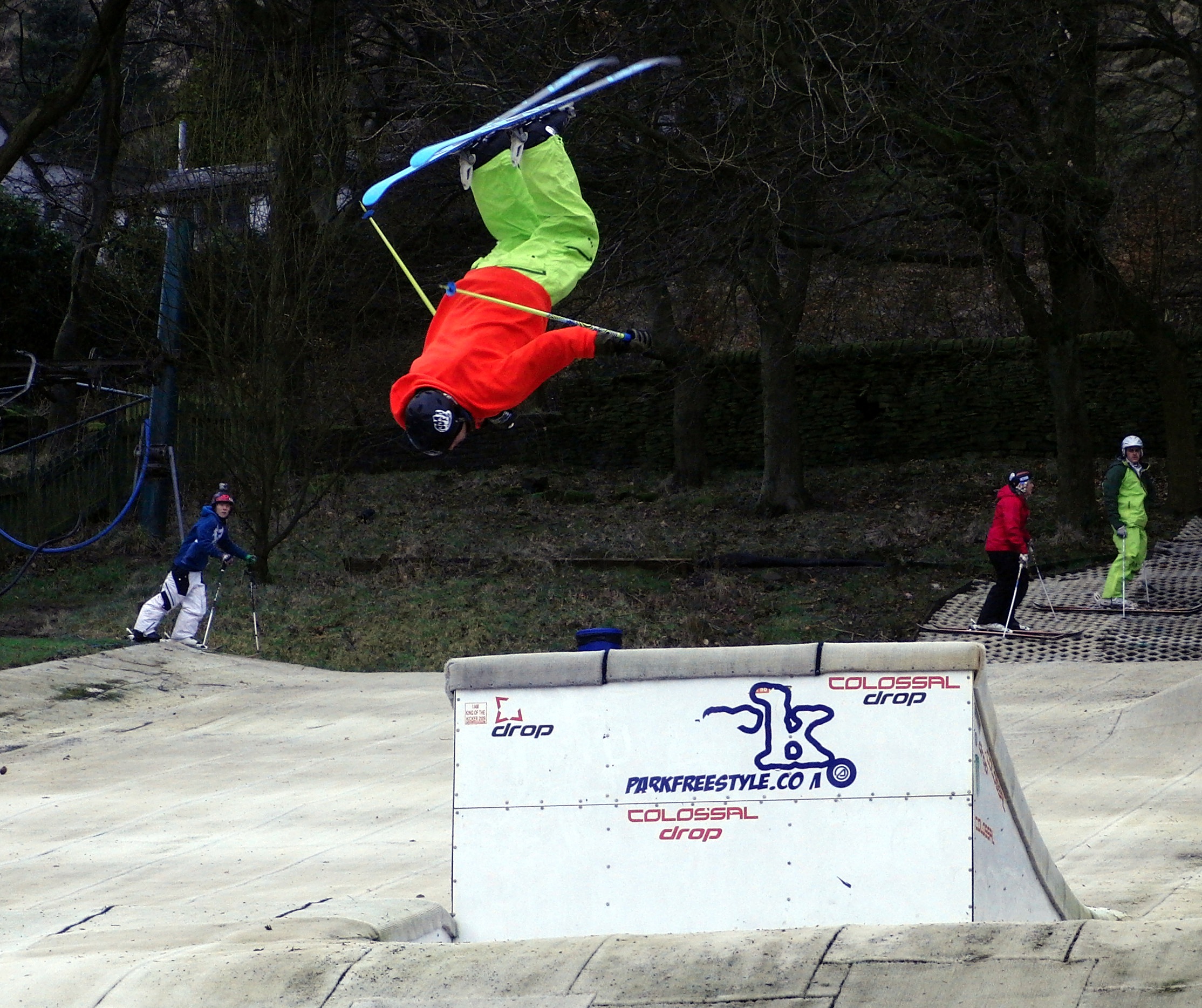
A couple of weeks ago I discussed the new Ski-Jump world record set in Norway, this time I’m reporting on another record set on UK soil (or a plastic ski slope to be more specific). The record I am referring to is the highest jump from a quarter pipe on a dry ski slope.
On a wet and windy day this February, I travelled to Rossendale Ski Slope in Lancashire with fellow Sports Engineer Heather Driscoll. Although I had visited the ski slope once before as a wide eyed and mal-coordinated teenager to try and learn to ski, I was returning as a nervous and mal-coordinated adult for a very different purpose.
A couple of weeks prior to the big event, the BBC had contacted us to ask whether we’d be able to measure the height of a skier’s jump. They were due to be on location to film some of the countries best ski talent and were hoping to set a new world record. This all sounded pretty exciting, our research centre has expertise in motion capture techniques and our specialist high-speed video cameras would be ideal.
Our technique was simple but effective. We positioned the cameras opposite the quarter pipe on the run in slope at the height which the skiers would be jumping. We levelled, zoomed and focused the cameras and after a quick calibration (measurement of an object of a known size) we were ready to go.
Once we’d set up we decided to watch the skiers ‘warming up’ for the imminent record attempt, impressive stuff. While I have trouble jumping over a ski, these guys found backflips, front flips and other confusingly named moves no problem.
The rain came just as filming was about to start, while this wasn’t ideal with regards to our personal comfort, it would actually help the record attempt. Artificial ski surfaces have come on considerably since their early days but still can’t get anywhere near the combination of low coefficient of friction and ‘carveability’ that snow can allow. A good soaking would help lower the resistance between surface and ski, help the skier gain more kinetic energy (speed) and translate more of this into jump height.
As the potential record breakers got to grips with the quarter pipe, Heather and I tested the measurement system. To calculate maximum height we measured the distance in the high-speed images between the lowest point of the skier (at the apex of the jump) and the lip (top) of the quarter pipe. By comparing this distance to our calibration object we had an accurate value of the height of the jump (see a great series of videos by Manchester Metropolitan University for more information regarding 2D video analysis). Luckily, at the apex of a jump all of the kinetic energy (motion) has been translated into potential energy (height) so velocity is at a minimum. This allowed us to keep exposure times long for better image quality.

Nine expert skiers were vying for the record. The official from Guinness had proclaimed that in order to be a ratified record (this was the first attempt) a height of over 2.00 metres had to be recorded. It soon became apparent that this wouldn’t be a problem, cheered on by a soaked but endlessly enthusiastic group of local school children, the heights continued to increase well beyond the 2 m mark.
After three jumps each, the results were in, the new world record is an astonishing height of 2.87 metres, with the evident favourite of the day missing out by only a single centimetre!
Well done to all the talented skiers involved, I’ll be watching intently to see if the height can be bettered.
Uk readers can check out the programme on the BBC website
Simon Choppin
 Engineering Sport
Another great post Simon; I especially liked your experimental set up diagram…. fancy!
Anyway I have two comments:
1. Is speed of approach the critical factor, or is it the ‘pop’ off the the top of the ramp? In my limited experience, the faster one goes when approaching a jump, the more likely one is to miss a good ‘pop’ off the top of the ramp thus effectively squashing your potential height. This is presumably because there is simply less time to push off at the right moment. I guess my point is that a faster approach doesn’t always mean a higher jump.
2. Where are you keeping your Blue Peter badge?
Dave
LikeLike
Thanks for the kind words Dave,
As you know, my experience in ‘big air’ is limited in the extreme although from my understanding of dynamics I’ll have a stab at a coherent answer to your questions.
I think the ‘pop’ of a jump is all about using the shape of the jump to change your trajectory. In the case of a smaller ‘kicker’ type jump (as opposed to a half pipe or quarter pipe) this means utilising the lip of the jump to change the velocity of your centre of mass. If you’re not ready for it there’s a chance that you can ‘absorb’ the ramped lip and have a lower trajectory than desired. This is why I think larger ‘big air’ jumps have a longer run in and less of a transition at the end of the jump. In the case of a half pipe, the large curve and vertical slope helps to transfer your velocity from a diagonally downward trajectory (in the case of a run-in slope) to purely vertical. Obviously there will still be effort required to stop your body flying straight into the ramp, and the faster you’re going the more energy will be required to do so. But in the case of big air, I think speed still reigns supreme.
To answer your second question, my badge is in a sturdy, locked box labelled ‘family heirlooms’ although I do occasionally remove it and marvel at it for a while.
Thanks again for you comment
Simon Choppin
LikeLike