
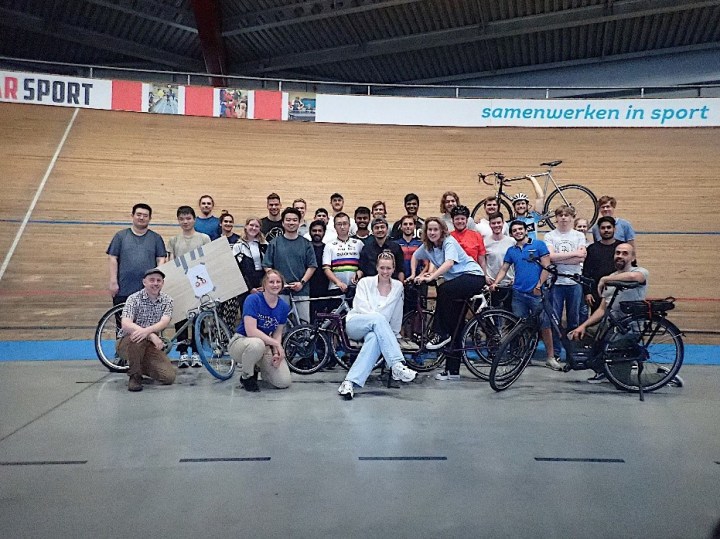
The first two weeks of July had been long anticipated for students, like me, enrolled in the Special Topics in Sports Engineering course for 2023. Organized through the Alliance for Sports Engineering Education (A4SEE), this course welcomes master’s students in related MSc programs registered at one of the A4SEE partner universities (https://a4see.com/partners). Each year, Delft University of Technology hosts this 2-week summer school in the beautiful city of Delft, Netherlands. For a lot of us students, it was our first time visiting the country, and we all enjoyed exploring all that the Netherlands had to offer on the weekends and evenings. The many canals and historic buildings provided a wonderfully quaint backdrop for walking and cycling. It was very apparent that the Dutch love riding bikes and this mode of transport also became popular amongst my fellow students whilst travelling to and from the university!
To kick off the week, we all gathered on Monday for ice-breaker activities and some introductory challenges and experiments. This was a great way for us to get acquainted with our group members whom we would be working with for the assignments and final project. We also got a first taste of the amazing lectures to come over the two-week period, where the opening lectures covered the topics of modelling bicycle performance from Dr. John Hart, and thermal physiology from Prof. Dr. Hein Daanen. A social activity finished the day off at the ID Kafe on campus, where we all got to try out some cool new designs and technologies being developed at the TU Delft Bicycle Lab led by Dr. Jason Moore. One of the bikes incorporated a balance assist system that can self-steer at low speeds to help a rider stay upright (https://mechmotum.github.io/research/balance-assist-bicycle.html)!
As the week progressed, we were given the first assignment which involved testing aerobic and anaerobic capacities using both simple equipment and more refined methods. We had more engaging lectures from Dr. Mathijs Hofmijster, Sam Brockie, Dr. Mark de Zee, Dr. Eline van der Kruk, Gabriele Dell’Orto, Harm Ubbens, and Dr. Jason Moore. These were all very helpful for completing the assignments and allowed us to delve deeper into the many different avenues of sports engineering within cycling. Topics covered included power generation and performance optimization, as well as musculoskeletal modelling and rolling resistance of bike tires. I felt very lucky to attend lectures from academics and researchers from around the world. To be given the chance to ask them questions, learn from their experiences, and be inspired by their work was an invaluable aspect of the course.

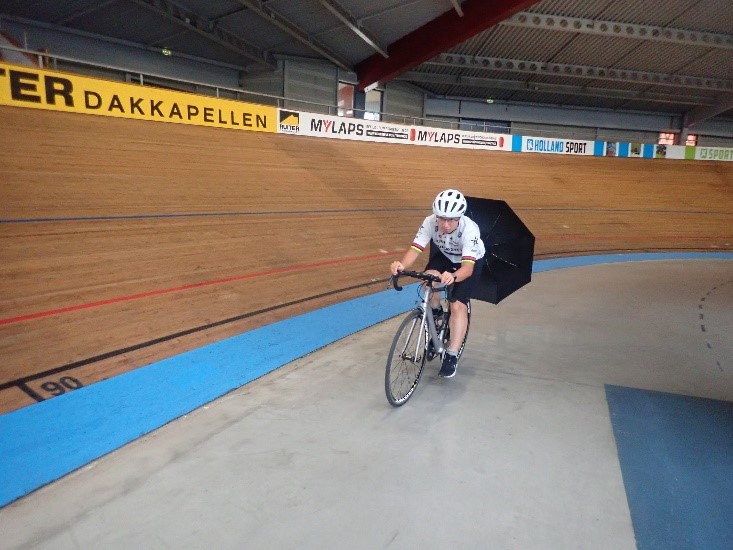
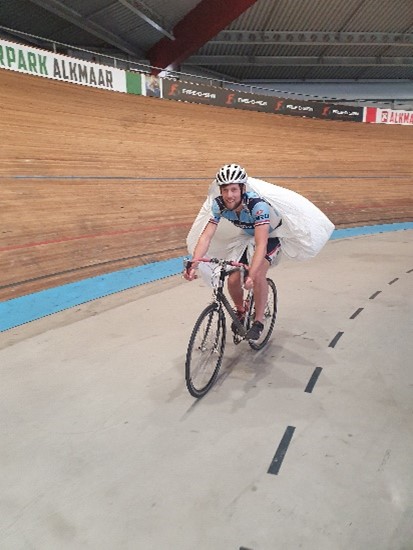
The second week comprised a greater amount of group work as we completed both the second assignment and the final project. The second assignment challenged us to calculate the aerodynamic drag and rolling resistance coefficients of a cyclist and come up with ways in which to drastically change these values. Teams came up with creative solutions to this problem and had fun experimenting with bedsheets, umbrellas, and even parachutes!
Monday included an exciting visit to the Open Jet Facility (https://www.tudelft.nl/lr/organisatie/afdelingen/flow-physics-and-technology/facilities/low-speed-wind-tunnels/open-jet-facility) to do some testing with a wind tunnel capable of speeds of up to 35 m/s! We examined the effects that different textures of skin suits had on the aerodynamic drag of cyclists. After the tests, we also got the chance to experience the power of the wind tunnel (thankfully not at full speed!).

This week we were lucky to have lectures from Dr. Wouter Terra, Prof. Dr. Frans van der Helm, Dr. Marcus Dunn, and Dr. Stefan Schwanitz comprising topics of ethics in sport, cycling biomechanics and aerodynamics, and mechanical shock and vibration in cycling. These lectures presented many interesting ideas and information that stimulated productive discussions among students. I appreciated that these lectures explored the vast avenues of sports engineering that we could pursue in our future careers.
The final project allowed us to take all that we had learned during the 2-week course and apply it to create a predictive model for track cycling. We got to source any bike and cyclist of our choosing and model the velocities and power generation curves of a time-trial around a track. Teams got creative in their bike selections: we saw electric bikes, road bikes, touring bikes, and even a Bakfiets cargo bike! In order to successfully complete the challenge, we had to collect a lot of data, conduct a lot of programming, and undertake even more experimentation to ensure our predictions would be accurate!
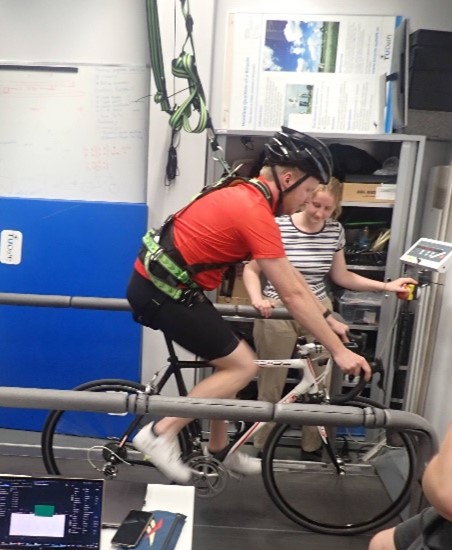
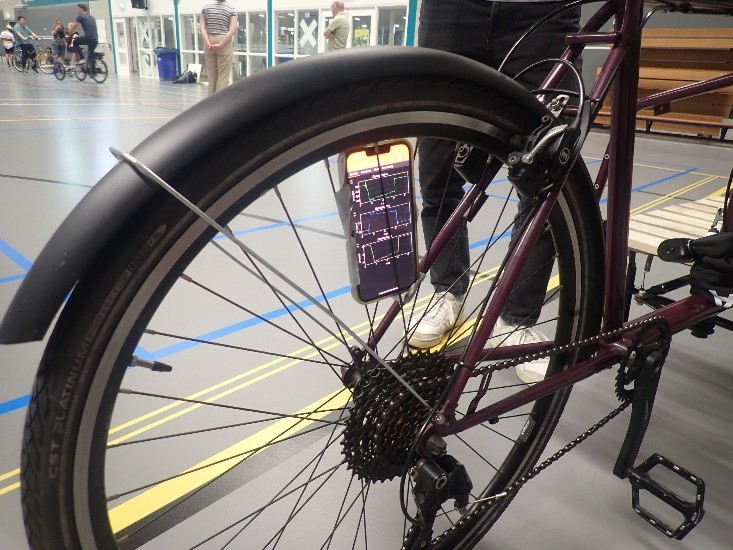
On the final day, we got to test our predictions at the Alkmaar Velodrome. After a lot of work creating and refining our models, my fellow students and I enjoyed a day out at the velodrome cheering on our cyclists and seeing how close our predictions were to the actual time-trials. We also got to try out riding on the track at the end of the day where the Bakfiets was a huge hit (though not the best when riding the banks!).
On top of days full of learning and coursework, we had plenty of time to relax, enjoy the summer weather, and socialize. Some of my favourite activities were playing beach volleyball on the campus courts, a group social night with boardgames and pétanque (a game where the objective is to get metal balls – called boules – close to a target), and spending time relaxing by the canals and exploring the city.


Something I enjoyed about this course was meeting people from around the world who shared an interest in sports engineering. By the end of the week, we had all become very good friends and enjoyed getting to know each other and collaborating on projects. As a fellow teammate said, “The best part of the two weeks in Delft for me was the opportunity it provided to see and learn more about how people from different parts of the world approach a problem. Since the groups represented good demographic variation among members, it was interesting to work with people who have come from different educational upbringings.”
All in all, this was a course to remember! The lectures were interesting and thought-provoking, and the assignments and final project allowed us to experiment, implement the knowledge we had acquired over the two-week course, and test our engineering skills. The most important takeaway for me is that this course has strengthened my interest in pursuing a career in sports engineering. I am grateful to have learned from and collaborated with the global sports engineering community comprising academics, researchers and students.
You can find ore information about the MSc Special Topic course here.


[…] Moreover, my internship allowed me to embark on various work-related travels, participating in off-site testing and A4SEE events. These included the Innovation Marketplace in Vienna, Austria, the Industry Collaborative Experience (ICE3) in Chemnitz, Germany, and the Special Topics in Sports Engineering Summer School in Delft, Netherlands. You can read about the ICE3 course here, and my experience completing the Special Topics in Sports Engineering course here. […]
LikeLike